
The first week of November had a common thread, and it was not complication count. It was surface. Polishing, anglage, bridges and enamel — the parts of a watch where hours of work are visible — have become the place where brands tell their story again.
Louis Vuitton's Tambour Convergence Mirror Steel begins with a 37mm case machined from a proprietary hardened steel that the house says is nearly six times harder than standard, quoting 1,130 Vickers, before being polished to a full mirror finish. LV notes that the case alone takes up to three times as long to produce as the rose gold version. Inside is the in-house LFT MA01.01 automatic from La Fabrique du Temps, running at 4Hz with 45 hours of reserve. The real argument, though, is the display: two satin-brushed discs rotate beneath an arched, scalloped aperture to indicate hours and minutes, with a sculpted lozenge between them as the reference point, a shape drawn from the display window of the family home in Asnières. A grey Saffiano calf strap completes it. Around $43,000, and part of the permanent collection rather than a limited edition.
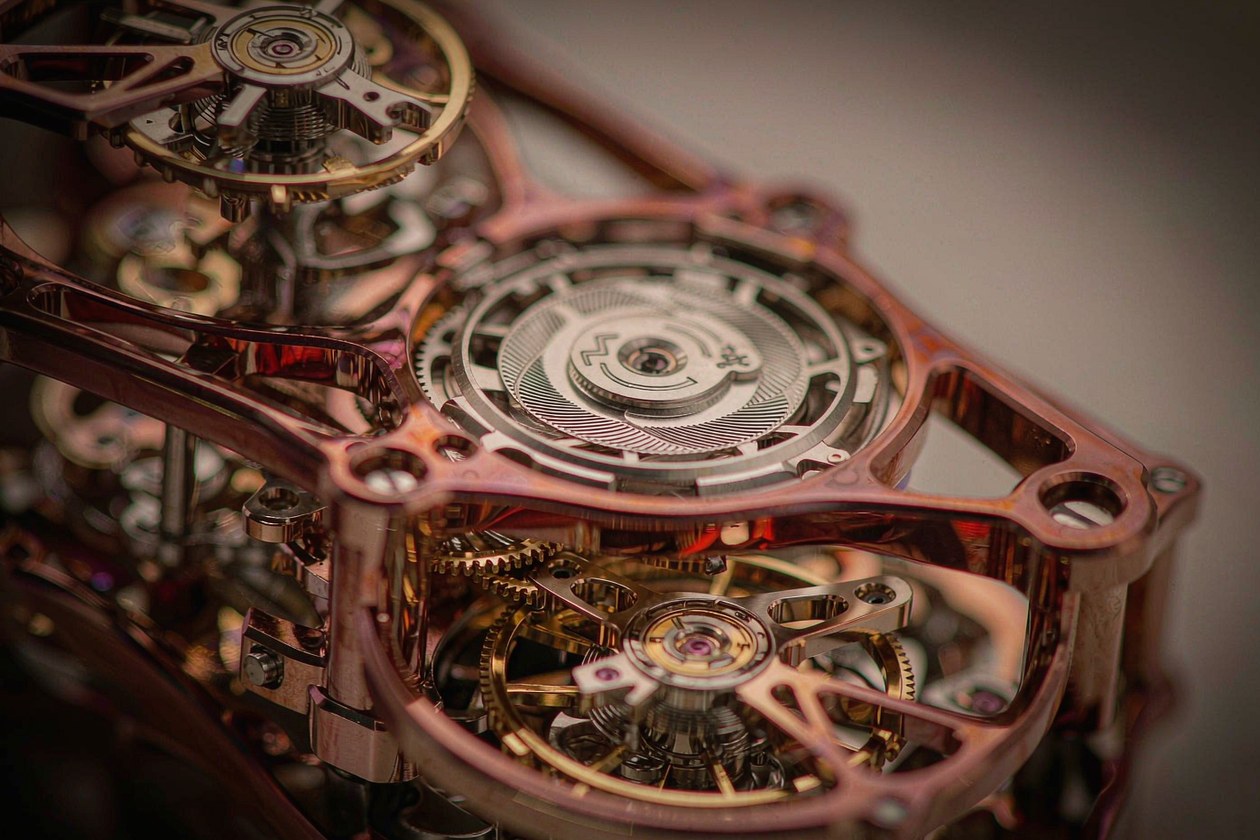
Girard-Perregaux's Laureato Fifty Three Gold Bridges takes the 50-piece anniversary edition of 2025 and makes it a permanent steel reference. The 41mm case is 10.85mm thick, with a white gold octagonal bezel; three rose gold bridges span the dial side, a platinum micro-rotor sits at 12 o'clock and a tourbillon at 6 in a lyre-shaped titanium cage. Calibre GP9620 uses 303 components and 33 jewels, beats at 3Hz, holds at least 55 hours and measures 32mm across. The finishing numbers are the ones that matter: 418 hand-polished angles, 362 of them inward angles, which cannot be produced by machine and can only be cut at a bench. Each watch is assembled and regulated by a single watchmaker, whose initials appear on a small arrow-shaped plate on the bridges. $182,000.
Laurent Ferrier's Grand Sport Tourbillon Iceberg measures 44mm by 13.4mm in grade 5 titanium and weighs just 118 grams on its integrated titanium bracelet. The opaline white dial carries blue nuances, which is where the name comes from; inside, the hand-wound LF619.01 tourbillon offers more than 80 hours of reserve. CHF 175,000.
Vacheron Constantin's Métiers d'Art zodiac series reaches the Year of the Goat for 2027: two 25-piece editions in 950 platinum and 18K 5N pink gold, 40mm cases, dials built from relief engraving, miniature painting and Grand Feu enamel. Calibre 2460 G4's hands-free display clears the centre of the dial for the artwork, with 40 hours of reserve and the Hallmark of Geneva. Price on request.
TAG Heuer's Formula 1 Solargraph x Oracle Red Bull Racing uses a 38mm sandblasted steel case, a blue sunray dial, a red flange and a yellow central seconds hand. The solar TH50-00 movement draws on natural or artificial light and runs up to ten months on a full charge. At $2,250 in the United States it is by some distance the cheapest watch in this group, and evidence that the entry tier keeps innovating on its own terms. The launch was timed to the 2026 United States Grand Prix, marking ten years with the team.
One reading: the most informative watches this week were at the two ends, not the top. A $43,000 mirror-polished steel piece and a $2,250 solar watch answer the same question — when there is no complication to talk about, why should anyone pay? The answers are labour and utility. The $175,000 and $182,000 pieces answer differently: this watch can only be made this one way.
Sources: Robb Report, Time+Tide, Design Scene, and official material from Louis Vuitton and Girard-Perregaux. Compiled and analysed by MWrist Editorial.


