
Start with the numbers. On 7 and 8 November, Phillips in association with Bacs & Russo held The Geneva Watch Auction: XXIV at the Hôtel President Wilson, taking CHF 92,045,568 — roughly $112.3 million — across two days. It is the first live watch auction to clear the $100 million mark, and the previous record belonged to Phillips itself, set only six months earlier.
All 217 lots sold. Twenty-four world records, seventeen lots above CHF 1 million, an average of more than $500,000 per lot, and 2,121 registered bidders from 69 countries.
The top price went to an F.P. Journe: a platinum Chronomètre à Résonance "Régence", the only example with a hand-engraved, polished pink gold dial, at CHF 8,680,500 (about $10.59 million). That also makes five consecutive Phillips live sales with a single watch above $10 million.
Journe carried the night. Thirteen pieces brought CHF 31.8 million in total, including the "Tokyo Boutique" Résonance at CHF 6,146,000 and the diamond-set Vagabondage III at CHF 5,057,000. One independent brand accounted for a third of the entire sale.
The traditional segment did not step aside. A stainless steel Patek Philippe ref. 1436 split-seconds chronograph — one of only two known to retain both its original steel case and dial — made CHF 6,267,000, fifty-seven per cent above its high estimate. Cartier's Portico Mystery Clock No. 4 of 1924, one of six and the only one with a hexagonal rock crystal dial, reached CHF 4,815,000, a world auction record for any Cartier object. A yellow gold Rolex ref. 6062 "Stelline" made CHF 2,334,500 and a 14-carat gold Daytona ref. 6241 "John Player Special" CHF 1,905,000. Among independents, Philippe Dufour's platinum Simplicity took CHF 1,968,500 and Kari Voutilainen's tantalum Vingt-8 Inversé CHF 1,524,000, while Sylvain Pinaud's Origine No.2 reached CHF 609,600 — more than five times its high estimate.
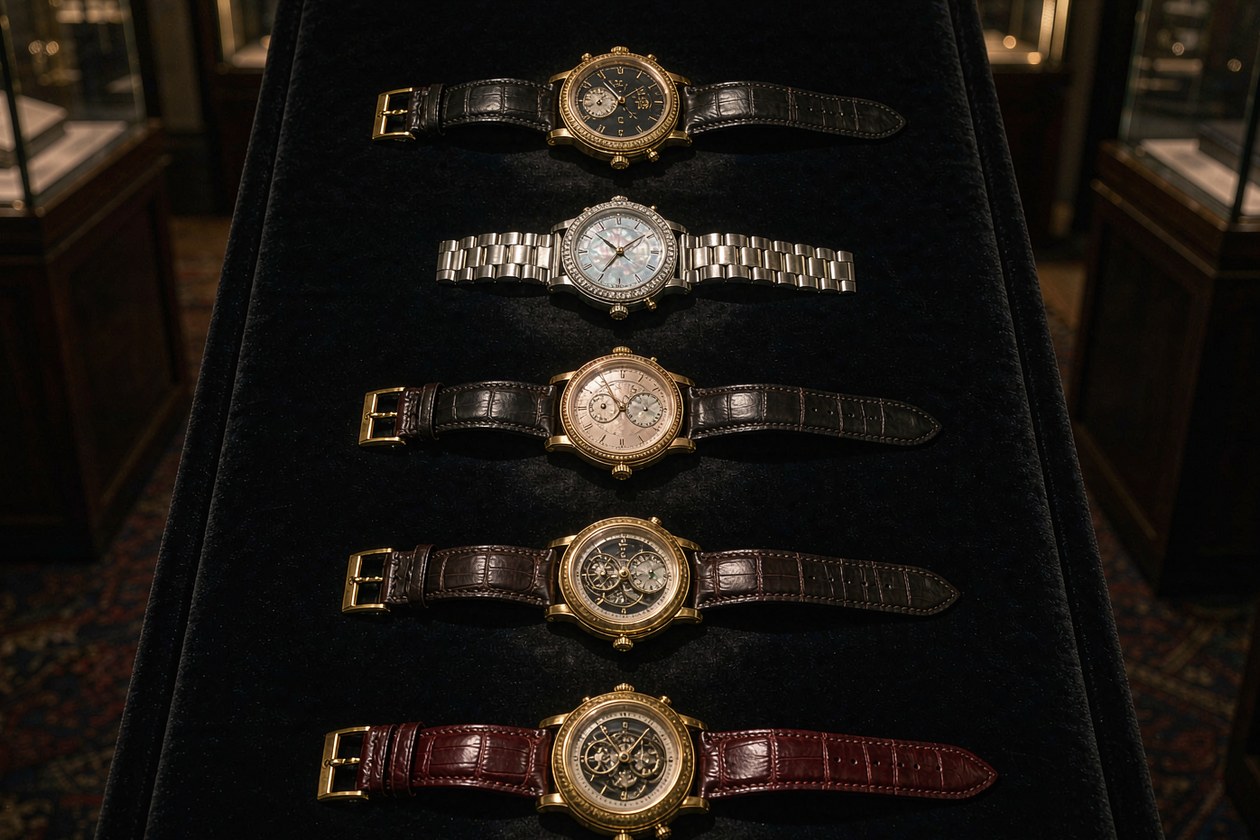
A weekend earlier, Monaco Legend's Exclusive Timepieces 43 produced a different kind of extreme: 234 lots offered across two sessions on 31 October and 1 November, all 234 sold, for €22.26 million. That total sits about 15.9 per cent below April's €26.47 million across 288 lots, but the sell-through rate rose from 98.3 to 100 per cent.
The headline lot was a stainless steel Rolex ref. 6062 triple calendar moonphase with the rare two-tone Explorer dial: bought new in 1955 by a Hong Kong-born graduate of Imperial College London, it stayed with its first owner for six decades before joining John Goldberger's collection in 2017. Two custodians in more than seventy years, and €1,858,000. Behind it came a yellow gold Patek Philippe ref. 2499/100, fourth series, from 1982 and believed to carry the first ref. 2499 case made by Patek's own Ateliers Réunis, at €1,424,000; a ref. 3974 in yellow gold from 1990 with a Hagmann case at €1,144,000; and a white gold Nautilus ref. 3700/1 from 1978 on a Gay Frères bracelet at €858,000. The clearest lesson in scarcity pricing was a rectangular platinum Audemars Piguet triple calendar moonphase, described in the catalogue as possibly unique, estimated at €200,000–400,000 and sold for €728,000.
Read together, the two sales do not support the lazy conclusion that the market is simply hot. What drew competitive bidding was narrow: top-level vintage with a documented chain of ownership, and contemporary work with independent watchmaking credentials. The middle was harder work — Monaco's 6062 landed mid-estimate rather than at the top of a €1–2 million range, and on secondary platforms ordinary hype references are meeting resistance, with asking prices now requiring a buyer's agreement rather than assuming one. Scarcity is scarce and the rest is ordinary; that split tells you more than the totals do.
Sources: official releases from Phillips and Monaco Legend Auctions; Instituto Português de Relojoaria; Timekeepers Magazine; The Watchology. Compiled and analysed by MWrist Editorial.


